

Key takeaways
- Extracorporeal shockwave therapy (ESWT) uses acoustic pressure waves, not electricity, to trigger a healing response in damaged tendon and soft tissue.
- It is most established for plantar fasciitis and Achilles tendon problems that don’t improve with rest, stretching, orthotics, or physiotherapy.
- It is usually part of a wider rehabilitation plan, not a stand-alone fix.
- A typical course is 3 to 6 sessions, one to two weeks apart. Real change tends to build over several weeks, not overnight.
- It is not completely painless or risk-free, so a proper clinical check is important. UK guidance treats it as safe but is more cautious about efficacy than much of the marketing suggests.
- At Foot and Ankle Treatments, Mr Francesc Malagelada can assess whether shockwave therapy is right for you and discuss minimally invasive surgery if conservative treatment doesn’t resolve things.
This guide is for anyone looking for information before deciding whether to go ahead with shockwave therapy. People living with plantar fasciitis or Achilles pain, runners returning to training, and anyone weighing NHS against private care may find it useful. Mr Francesc Malagelada is a Consultant Trauma and Orthopaedic Surgeon who specialises exclusively in foot and ankle conditions, offering a full range of foot and ankle treatments across four London clinics. You do not need a GP referral to book an assessment with him.
What Is Shockwave Therapy?
Shockwave therapy, or extracorporeal shockwave therapy (ESWT), is a non-invasive, non-surgical treatment that fires short pulses of acoustic pressure energy through the skin into damaged tendon or soft tissue. “Extracorporeal” means the treatment is generated outside the body, and no electricity passes into it. Devices are either focused, aiming energy precisely at a specific point, or radial, spreading energy more broadly across a wider area. The choice will depend on your condition.
How Does Shockwave Therapy Work?
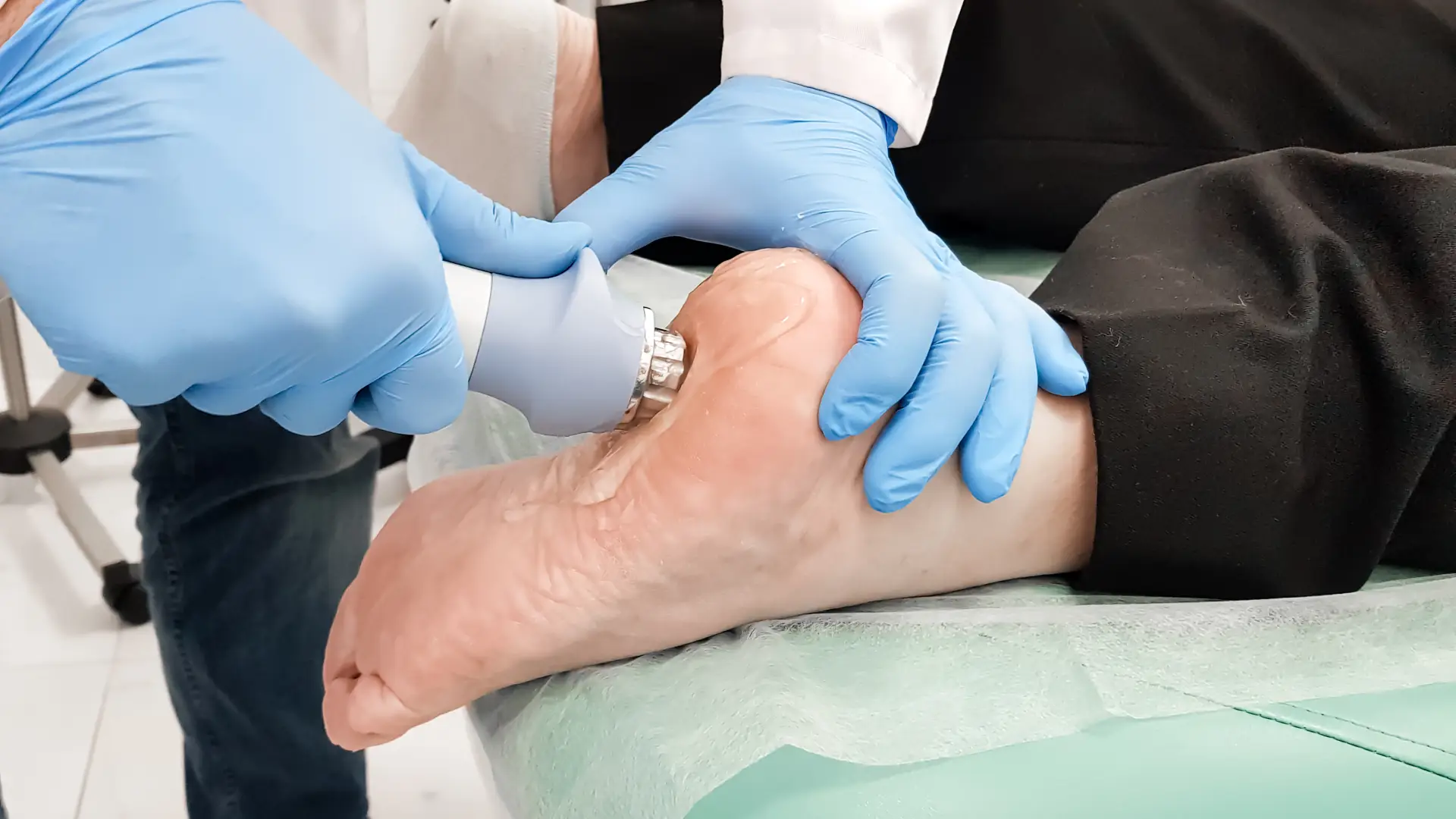
A handheld applicator delivers pressure pulses through gel into the target area, similar to an ultrasound scan. This is believed to trigger a local healing response by increasing blood circulation and changing how pain signals travel through nearby nerves. The exact mechanism is not fully understood, but many patients report improvement after treatment. Shockwave energy may also help break down small calcium deposits linked to chronic tendon problems. This effect has not yet been firmly established.
What Foot and Ankle Problems Can Shockwave Therapy Help With?
Plantar fasciitis (plantar fasciopathy)
Plantar fasciitis, or plantar fasciopathy, causes heel pain that is usually worst when you get out of bed in the morning. This is the main condition shockwave therapy is used for, and it is considered after initial conservative treatments haven’t provided enough improvement.
Achilles tendon problems
Achilles tendinopathy causes pain and stiffness in the tendon, which often gets worse after exercise. Shockwave is used for both insertional and midportion Achilles tendinopathy, usually once pain has become persistent. For the small number of patients whose symptoms do not settle, surgery may eventually need to be discussed, but shockwave and rehabilitation are tried well before that stage.
Other foot and ankle conditions
Shockwave is also used for heel spurs and some chronic tendon problems elsewhere in the foot and ankle, though evidence for these uses is thinner. Ask your clinician what the evidence looks like for your case.
Typical treatment course
- 3 sessions: a common protocol used by some NHS services.
- 4 to 6 sessions: used by some services and private clinics, particularly for more persistent cases.
- Interval: usually around 1 week, sometimes 1 to 2 weeks between sessions.
- Follow-up: depends on your provider and how your specific condition responds.
When Is Shockwave Therapy Recommended?
Shockwave therapy is generally considered after proper diagnosis and following a period of conservative management that has not provided enough relief. This includes activity changes, a structured exercise programme, physiotherapy and orthotics. It is normally part of a wider rehabilitation plan rather than a replacement, and skipping the exercise programme you are given alongside it can reduce your chances of a good outcome.
If shockwave and other conservative measures do not settle things, Mr Malagelada will discuss whether minimally invasive keyhole surgery is an appropriate next step. The aim is to reduce pain and scarring and help you return to normal life sooner than with traditional open surgery.
What Happens During Shockwave Therapy for the Foot or Ankle?
A typical session follows a similar pattern. Details will vary a little by clinic and condition:
- Assessment: your clinician checks the area and identifies the most tender point, usually by pressing to find where the pain is sharpest.
- Positioning: you sit or lie down with the foot supported.
- Gel applied: a conductive gel is applied over the treatment area, similar to an ultrasound scan.
- Applicator placed: the handheld device is positioned against the skin over the marked point.
- Pulses delivered: the device delivers a set number of pressure pulses, typically 1,500 to 2,500.
- Intensity adjusted: your clinician adjusts the intensity according to your tolerance and feedback.
- Treatment completed: the applicator is removed, and the gel is wiped away. Most appointments take fifteen to twenty minutes in total.
Is Shockwave Therapy Painful?
Most people find it uncomfortable, not unbearable. It’s often described as a sharp, tapping sensation over the sore spot that builds for the first minute or so, then eases. Your clinician can adjust the intensity if it feels like too much. Afterwards, some soreness or a temporary flare of pain is common for a day or two, similar to a muscle after unaccustomed exercise. This doesn’t mean anything has gone wrong.
How Many Shockwave Therapy Sessions Do You Need?
The number of sessions you need will depend on your condition and how you respond. It’s not a fixed number. Most clinicians check your progress at each appointment and decide how many more sessions you need, rather than committing to a set course from day one.
How Long Does Shockwave Therapy Take to Work?
This is the most-asked question, but also the hardest to answer. Some patients notice an early change within one to two weeks, but for many it’s a gradual change over several weeks. The Royal Orthopaedic Hospital’s patient guidance says many patients see pain reduction around six to twelve weeks after their final treatment, while still continuing rehabilitation exercises. There is no guaranteed timeline.
What Are the Side Effects and Risks?
Shockwave therapy is not risk-free. It helps to know what is common and temporary, and what is rare but more serious.
Common and usually temporary
- Pain or discomfort during and shortly after treatment.
- Redness over the treated area.
- Bruising.
- Swelling.
- Short-lived numbness or altered sensation.
Less common or rare
- Tissue damage.
- Tendon or ligament rupture.
- Persistent symptoms that do not settle.
- Other complications specific to your particular condition.
Serious problems are rare when a trained clinician delivers treatment with the right settings. You should be told about the risks before you agree to treatment.

Get an expert opinion on your ankle injury
Mr Francesc Malagelada is a Consultant Trauma and Orthopaedic Surgeon and a senior trauma consultant at the Royal London Hospital, where he treats ankle fractures of all severities. You don’t need a GP referral to book a specialist assessment.
Who Should Not Have Shockwave Therapy?
Shockwave therapy may not be suitable, or may require extra caution when a patient has certain conditions. These include:
- Pregnancy
- Active infection at or near the treatment site
- Certain cancers or tumours in the treatment area
- Clotting disorders
- Anticoagulant or antiplatelet medication (blood thinners)
- Cardiac devices such as a pacemaker (this is device-dependent, and should always be checked with the clinic)
- A recent steroid injection in the treatment area
- An acute tendon or fascia injury, rather than a chronic one
- Certain neurological or other medical conditions
This is general guidance, not a personal assessment. A qualified clinician who knows your full medical history needs to check whether shockwave is right for you.
What Should You Do After Shockwave Therapy?
You can usually return to normal, light activity straight away. Most clinicians advise avoiding high-impact exercise such as running for the first 48 hours. Paracetamol is usually fine for pain relief, and some clinics advise against anti-inflammatories or icing in the days around treatment, since shockwave depends on a normal inflammatory response. Ask your own clinician, since guidance can vary. A gradual return to exercise and sticking with your rehabilitation programme matter just as much as the sessions themselves.
Shockwave Therapy vs Other Treatments for Foot and Ankle Pain
There isn’t a universal best choice. Shockwave sits as one option within a broader pathway, and the right choice depends on how long you have had symptoms, what you have already tried, and your clinician’s assessment.
How the main options compare
- Exercise and rehabilitation: usually first-line, or used alongside other treatments. Not invasive. Requires consistency to work.
- Orthotics: used for selected patients. Not invasive. Addresses how the foot is loaded and supported.
- Shockwave therapy: considered for persistent symptoms. Not invasive. Most effective when used alongside an ongoing rehabilitation programme.
- Steroid injection: used in selected cases. Minimally invasive. Can ease pain quickly, but repeated use carries risks and limitations such as tendon weakening.
- Surgery: reserved for selected refractory cases. Increasingly performed using minimally invasive, keyhole techniques. Carries a recovery period and the usual surgical risks.
Frequently asked questions
Is shockwave therapy painful?
Most people find it uncomfortable but not painful enough to stop the treatment. It typically feels like a sharp, tapping sensation directly over the sore area. Your clinician can adjust the intensity if it feels like too much.
How many sessions of shockwave therapy will I need?
Most courses involve three to six sessions, one to two weeks apart. The exact number depends on your condition, and your clinician usually reassesses this at each visit.
How long does shockwave therapy take to work?
It varies. Some people notice changes within a week or two, but improvement often develops over several weeks and can continue for up to three months after the final session.
Can I exercise after shockwave therapy?
Light activity is usually fine. Most clinicians advise avoiding high-impact exercise, like running, for about 48 hours after each session. You can then return gradually following your clinician’s advice.
What should I avoid after shockwave therapy?
Avoid high-impact exercise for the first 48 hours. Some clinics also advise against anti-inflammatories or icing, since this may interfere with the inflammatory response the treatment relies on. Ask your own clinician, since protocols vary.
Can shockwave therapy get rid of heel pain?
For many people with chronic plantar fasciitis, it can meaningfully reduce heel pain, particularly when combined with stretching and other conservative treatment. It does not work for everyone, and no clinician can guarantee a specific result.
Who should not have shockwave therapy?
Pregnancy, active infection, certain cancers and clotting disorders require extra caution. Also, people on blood-thinning medication, those with certain cardiac devices, a recent steroid injection in the area, or an acute rather than chronic injury may not be suitable. A qualified clinician should review your specific case.