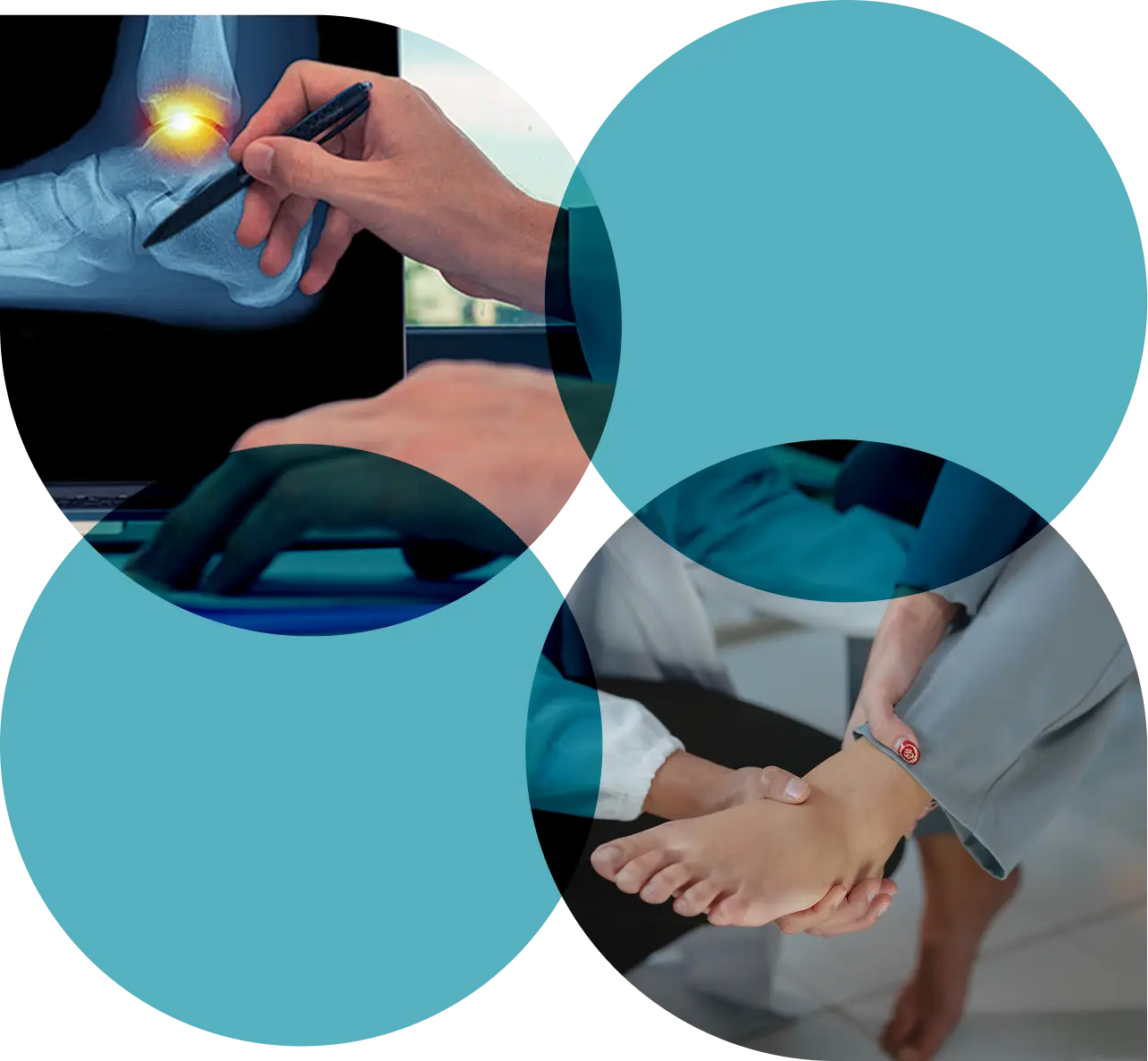
The Achilles is the strongest tendon in the body, and one of the most commonly injured. If the back of your heel aches when you run, feels stiff with your first steps of the morning, or has developed a tender lump, you may have Achilles tendinopathy, also known as tendonitis. If you felt a sudden snap and the leg gave way, the tendon may have ruptured. Both problems respond well to the right treatment at the right time.
Understanding Achilles Injuries
The Achilles tendon connects your calf muscles to the heel bone and transmits the force that lets you walk, run, and jump. Problems fall into two main groups. Achilles tendinopathy, often called tendonitis, is an overuse injury in which the tendon becomes painful, swollen, and gradually weaker. A rupture is a sudden tear, partial or complete, that usually happens during sport.
Tendinopathy tends to develop when load increases faster than the tendon can adapt. A new running programme, a return to sport after a break, or years of cumulative use can all trigger it, most often between 30 and 60. It can affect the mid-portion of the tendon or its insertion into the heel bone. Ruptures typically happen during a forceful push-off, and many patients describe a snap or the feeling of being kicked in the back of the leg.
If your heel pain has not settled with rest, or you have been told you may have torn your Achilles, a private consultation means you can be examined, scanned, and treated without delay. Ultrasound is used to confirm the diagnosis and, in ruptures, to measure the gap between the tendon ends, which guides whether surgery is advisable. For patients with private medical insurance, most treatment is covered. For self-funding patients, appointments are available at short notice at four central London clinics.
Symptom checklist
Symptoms differ depending on whether the tendon is irritated, degenerating, or torn. Tick anything that applies to you. The more that apply, the more important a proper assessment becomes.
If three or more of these sound familiar, you are overdue for an assessment. Early-stage tendinopathy responds far better to treatment than a tendon that has been sore for years. If you feel a sudden snap and cannot push off, treat it as urgent, because early treatment protects every option.
Treatment Pathway
Most Achilles problems, including many complete ruptures, do not need surgery. Treatment starts with an accurate diagnosis, a clinical examination supported by ultrasound where needed. The right pathway then depends on which part of the tendon is affected, how long symptoms have been present, and what you want to get back to. The goal at every stage is the least invasive approach that reliably works.

For tendinopathy, a structured loading programme is the foundation of treatment and, for most patients, the only treatment they need. Progressive calf-strengthening exercises stimulate the tendon to repair and remodel, alongside sensible changes to training load. For selected ruptures, early treatment in a specialist boot allows the tendon ends to heal without an operation, with outcomes that match surgery for many patients.
Structured calf-loading exercise programme
Footwear advice, heel raises, and orthotics where needed
Functional boot treatment for selected ruptures

When tendinopathy has not settled after months of structured rehabilitation, extracorporeal shockwave therapy can stimulate healing in the damaged portion of the tendon. It is delivered on site, in line with NICE guidance, as a short course of outpatient sessions with no downtime.
Shockwave therapy delivered on-site
A short course of outpatient sessions, no downtime
Ultrasound-guided injection therapies where appropriate

Surgery is considered when ultrasound shows a gap between the tendon ends that is unlikely to heal reliably in a boot, when a rupture is diagnosed late, or when tendinopathy has resisted months of structured care. Options include tendon repair, using minimally invasive techniques where suitable, debridement of damaged tissue, and reconstruction for chronic or neglected ruptures. Mr Malagelada has published research on the management of chronic Achilles ruptures. Every operation carries risks, including infection, blood clots, nerve irritation, and re-rupture, and these are discussed openly before consent.
Repair for acute ruptures, minimally invasive where suitable
Debridement for tendinopathy that has not responded
Reconstruction for chronic or late-diagnosed ruptures

LMS, PhD. Consultant Trauma and Orthopaedic Surgeon. Foot and Ankle.
Consultant at The Royal London
Board member, GRECMIP
Honorary Senior Lecturer
Mr Malagelada is a fellowship-trained Consultant Orthopaedic Surgeon who specialises exclusively in conditions of the foot and ankle. He trained in Spain and the UK, including at The Royal National Orthopaedic Hospital and The Royal London, and holds a BOFAS-accredited Foot and Ankle fellowship. He has been a Consultant at The Royal London Hospital since 2017, where he also teaches on the MSc in Orthopaedic Trauma Sciences.

Testimonials
Real patients. Real outcomes. Verified independently on Doctify.
Tendonitis, tendinitis, and tendinopathy all describe the same overuse problem: a painful, swollen, and gradually weakening Achilles tendon. Tendinopathy is the term specialists now prefer, because the underlying change is degeneration of the tendon fibres rather than pure inflammation. A rupture is different. It is a sudden tear of the tendon, partial or complete, that usually happens during sport and needs urgent assessment. The two are related because a tendon weakened by long-standing tendinopathy is more vulnerable to rupture.
Most people feel a sudden snap or a blow to the back of the leg, sometimes with an audible pop, followed by weakness, a limp, and difficulty rising onto tiptoes. Some can still walk, which is one reason up to 1 in 4 ruptures are missed at first presentation. The diagnosis is confirmed with a calf squeeze test and, where needed, an ultrasound scan. If you suspect a rupture, seek medical assessment straight away rather than waiting to see if it settles.
Yes, and for many patients, this is now the recommended pathway. If an ultrasound scan shows the tendon ends sit close together, treatment in a specialist boot with a structured rehabilitation programme achieves results comparable to surgery, with fewer wound-related complications. Where the gap between the tendon ends is larger than around 1cm, or the rupture is diagnosed late, surgery is usually advised. You can read more in Mr Malagelada's article on whether surgery is needed for an Achilles tear.
Whether treated in a boot or with surgery, expect around 8 to 10 weeks in a boot with heel wedges that are gradually removed, followed by months of progressive strengthening. Most people are back at a desk job within 1 to 2 weeks, driving once they are out of the boot and can perform an emergency stop, and playing sport at around 6 to 9 months. The tendon keeps strengthening for a year or more, and your rehabilitation plan is adjusted to your sport and your goals.
Rarely. Most tendinopathy settles with a structured loading programme, and shockwave therapy helps many cases that do not. Surgery, usually removal of the damaged portion of the tendon, is reserved for the small minority whose symptoms persist after at least six months of properly supervised non-surgical care. It is a genuine last resort rather than a first option.
Extracorporeal shockwave therapy (ESWT) delivers focused sound waves through the skin to the damaged part of the tendon, stimulating a healing response. It is used for Achilles tendinopathy that has not responded to initial treatment, in line with NICE guidance, and is delivered on site as a short course of outpatient sessions with no anaesthetic and no downtime. It is not suitable for ruptures, and results vary between individuals, but it helps many patients avoid injections and surgery.
No. If you are paying for your own care, you can contact the clinic directly, and appointments are available at short notice. If you are using private health insurance, the majority of major UK insurers, including Bupa, AXA Health, Aviva, Vitality, WPA, and Cigna, do not require a referral from a General Practitioner (GP) to see a private orthopaedic consultant for an Achilles problem. It is always worth confirming your individual level of cover with your insurer before your appointment, as policies vary. If you are unsure how to proceed, a member of the team is happy to guide you through the process.
Re-rupture is uncommon with modern treatment. In large studies, fewer than 1 in 20 patients experience a re-rupture, whether the original injury was treated surgically or in a boot with structured rehabilitation. The highest-risk period is the first few months, which is why the graduated rehabilitation plan matters as much as the initial treatment. Completing the plan properly matters more than which initial treatment you choose.
Appointments are available at short notice at four central London clinics, and a suspected rupture is prioritised because early treatment protects your options. If you felt a snap and cannot push off, contact the clinic straight away. If it is out of hours, attend an urgent treatment centre so the leg can be protected in the meantime. The sooner a rupture is confirmed and supported in the right position, the better the outcome, whichever treatment pathway you choose.
Every consultation, scan review, and operation is carried out under the care of Mr Francesc Malagelada, a fellowship-trained consultant orthopaedic surgeon who treats foot and ankle conditions exclusively. He is a senior trauma consultant at The Royal London Hospital and has published peer-reviewed research on Achilles injuries, including a review on the management of chronic Achilles ruptures. You see the specialist at every stage, from first assessment to final follow-up.
Still have questions?
Send a question using the form below. A member of the team will reply within one working day.